How we start.
One agent at a time. Three steps to the first agent, and after each one you decide whether to go on. Then, if you want more, a workflow audit and the next agents.
-
Step 1
A 20-minute call.
No data needed. Show us the work your team does by hand today.
- You bring
- How much of that work arrives by email on a normal day, and how many people spend more than half their day typing it into your systems. We ask; you answer.
- You get
- A straight answer on whether there’s enough manual work for an agent, and which workflow to start with.
-
Step 2
A test on your data.
Your past work. Your rules.
- You bring
- Some of your past requests, orders or estimates, and what your team sent for them. We agree the size together.
- You get
- The agent’s drafts beside your team’s work: accuracy and staff time, side by side with today.
-
Step 3
Pilot.
Live requests. Goals agreed first, with the person who can sign off.
- You bring
- Your live requests, and your team’s checks on every draft.
- You get
- Evidence from your own desk. We measure the time saved, and stop if there is none.
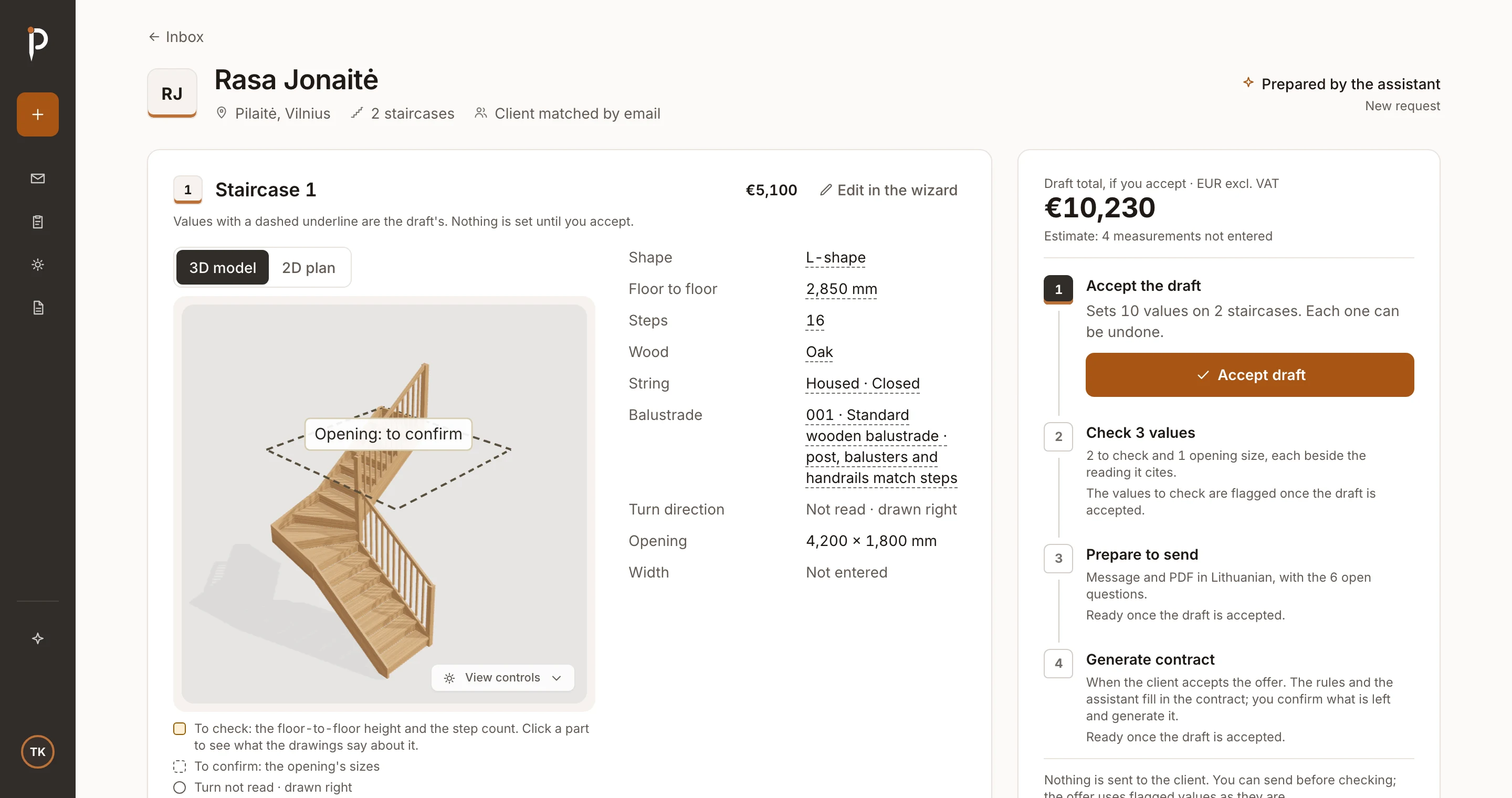
Step 2, on screen
Our draft beside what your team sent.
Each past request comes back as a draft with the source of every value. We put it beside the quote your team sent at the time; the difference is the result: what was read right, what was missed, and the time it took.
What a pilot includes
One team, one workflow, one inbox.
We build and run the agent, your team makes every decision, and more workflows and teams come after the pilot, one at a time.
The first scope
- One team
- One workflow, such as quote requests or order entry
- One inbox your requests arrive in
- Your catalogue and price lists, agreed up front
- Approved lines into your ERP, as a file it imports or a connection set up in the pilot
Timing depends on your requests, price lists and systems, and is agreed with you.
We build and run the agent
- Building the agent on your workflow and systems
- Drafting each piece of work for your team to check
- Setting up and running the agreed workflow
- Watching every draft, and putting your corrections into the next one
- Keeping customer item numbers, price lists and files up to date
Your team makes the decisions
- Sharing your catalogue and price lists
- Answering technical and commercial questions
- Approving everything before it goes out
-
Step 4
Workflow audit.
Paid. Price agreed before we start.
- You bring
- Time with the people who do the work, and a look at how requests move through your email, CRM and ERP.
- You get
- A written map of where the hours go, and a plan: which agents to build next, in what order, and what each should save.
-
Step 5
More agents, one at a time.
Each new agent starts with a test on your data, like the first. All of them run in the Perdika platform, where your team sees and approves their work.
How you pay
Workflow audit: a fixed price, agreed before it starts.
Each agent: a setup fee, then a monthly fee.
The setup fee covers building the agent on your workflow. The monthly fee covers running and improving it. We agree the amounts after the test.
Can we start with the audit? Yes, if you already know you want several agents. Say so on the call.
- We use your requests only for the test agreed with you. A data processing agreement is signed before it starts.
- During the test, text from the requests may be processed by Anthropic’s AI, Claude, under a data processing agreement. It is not used to train AI models.
- When the test ends, the material is deleted or returned, unless we agree otherwise in writing.
- Share only what you’re allowed to share, and remove what the test doesn’t need.
Talk to us.
On a 20-minute call, show us the work your team still does by hand. We tell you straight whether there is enough of it for an agent, and which workflow to start with.
Book a 20-minute callNo data needed for the call. Anything you share later is covered by a data agreement.
- Founder
- Matas EimutisOslo, Norway
- Reference
- Morta Pivoraitė-ŠimkuvienėCEO, LHM Step · reference on request